
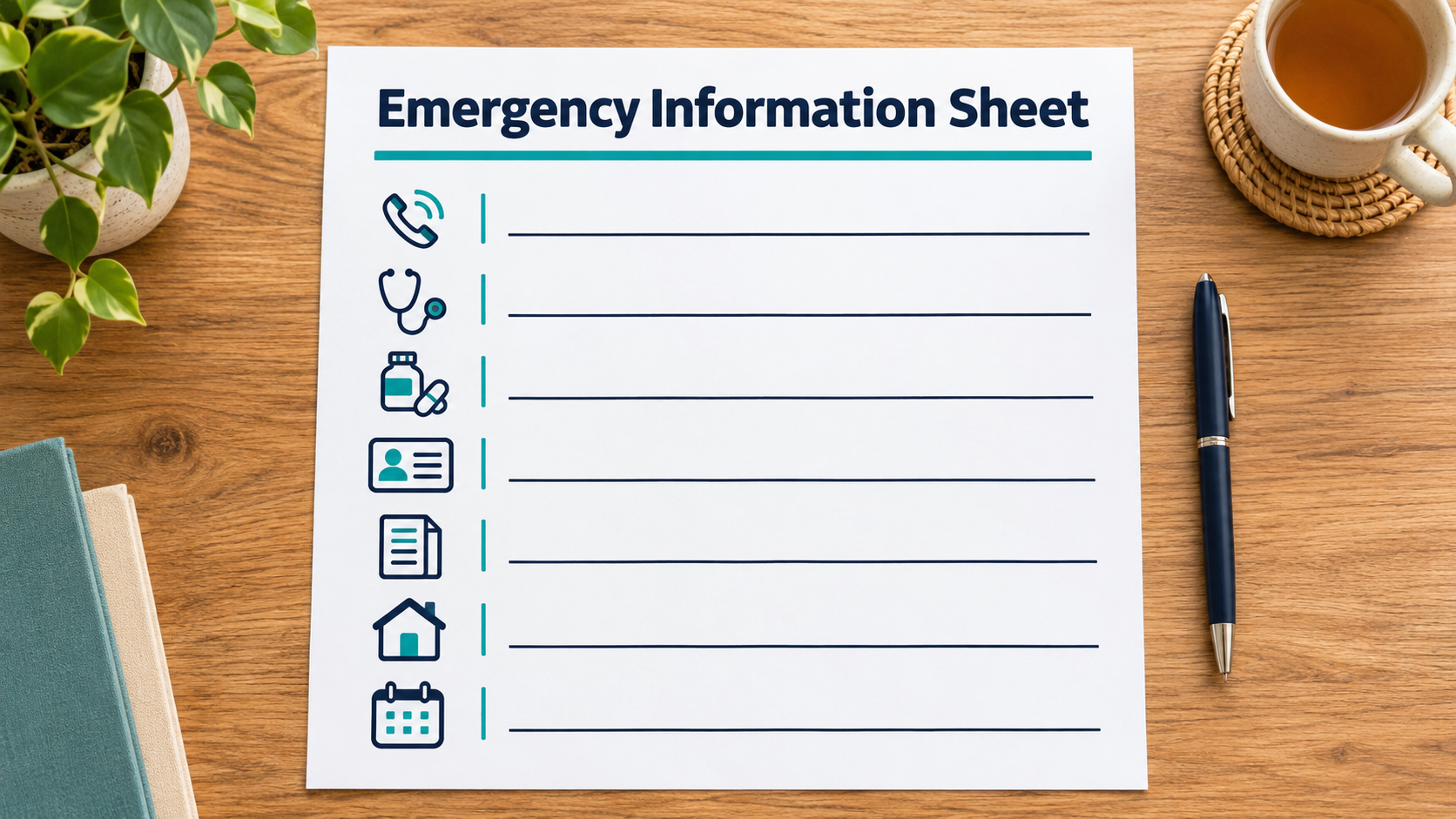
If a parent ends up in the emergency room, the first useful document may not be a legal form. It may be a single page that tells you whom to call, where to find an up-to-date medication list, and which doctor to contact. Make that page together while your parent can decide what to share. Keep it simple, date it, and agree on who may see it.
The goal is not to collect passwords, take over accounts, or build a secret family file. It is to make a stressful day less confusing without giving anyone more authority than they actually have.
Start with permission, not paperwork
Ask: “If you needed help unexpectedly, what would you want me to know, and who should I call first?” Your parent can choose a small emergency contact sheet without sharing every financial or medical detail. They may also prefer that a spouse, friend, or another relative hold the information.
Agree on the sheet’s purpose, where it will be stored, and when it may be used. If your parent declines to share something, record that it is private rather than trying to find it another way. A useful emergency plan can be built in stages.
The seven fields worth putting on one page
1. Names and preferred contacts
Include your parent’s preferred name, emergency contacts, relationships, phone numbers, and the order to call people. Add a backup contact who is likely to answer if the first person is unavailable. Ask whether any family member should not be contacted.
2. Health care contacts
List the primary care office, relevant specialists, preferred pharmacy, and their public phone numbers. If your parent has a preferred hospital, note it as a preference, not a guarantee that emergency responders can use it.
3. Where the current medication list lives
Do not rely on a half-remembered list. With permission, record where to find an up-to-date list of prescriptions, over-the-counter medicines, supplements, allergies, and relevant conditions. The National Institute on Aging’s caregiver worksheets include a medication-tracking worksheet. Keep the clinical details current with your parent and their care team; a one-page locator is not a substitute for medication reconciliation.
4. Insurance and identification location
Record where your parent keeps their health insurance card and identification. Avoid putting Social Security numbers, account numbers, or scans of identity documents on a sheet that might be carried around or posted on a refrigerator. A location note such as “insurance card in wallet” is often enough.
5. Medical decision-making documents
Ask whether an advance directive, health care power of attorney, or other relevant document exists and where the current signed version is stored. Note the designated person and their contact details only with permission. The rules, document names, and witnessing requirements vary by state. Being an adult child or an emergency contact does not automatically grant authority to make medical decisions.
6. Home, pet, and practical needs
A hospitalization may leave a pet waiting, food in the refrigerator, or a scheduled service at the house. List an authorized person who can handle urgent practical tasks and the best way to reach them. Do not assume that having a house key means permission to enter or manage property.
7. Last updated and who holds a copy
Put a review date at the bottom. Note who has a copy and where the original information is maintained. If a contact number or medication list changes, update the copies that matter. A short, current sheet beats a thick binder nobody can find.
What belongs somewhere safer
Keep banking passwords, PINs, recovery codes, complete financial account numbers, and copies of sensitive identity documents off a widely shared emergency sheet. If your parent wants help organizing financial records, make a separate, access-controlled document-location list. Knowing where a document is does not authorize using it.
The Consumer Financial Protection Bureau distinguishes informal bill-paying help from formal arrangements such as a power of attorney. Its financial caregiver guides explain that people acting with legal authority have duties to the person whose money they manage. A medical authorization and a financial authorization are not interchangeable.
A 20-minute conversation that produces something useful
Spend five minutes choosing the primary and backup contacts. Spend five identifying doctors, the pharmacy, and the location of the medication list. Spend five locating any existing medical decision-making documents. Use the last five to decide where the sheet lives and who may receive a copy. If a topic needs more discussion, write “deferred” and set a date to revisit it. Do not pressure your parent into signing anything during this exercise.
You can begin with a blank page headed “Emergency Information — Shared With Permission,” then use the seven fields above as prompts. The National Institute on Aging’s important-documents worksheet is a more detailed companion for families who want to organize records over time.
GO, INVESTIGATE, or WALK AWAY
GO: Your parent understands the purpose, chooses what to share, and agrees on who holds the sheet. Create the short version now.
INVESTIGATE: You cannot find an advance directive, contact details conflict, or a document may be outdated. Mark it as unresolved and ask the appropriate provider or qualified local attorney about next steps.
WALK AWAY: Someone proposes copying private records without permission, collecting account passwords “just in case,” or treating a contact sheet as legal authority. Stop and choose an authorized, less intrusive approach.
The most useful next step
Ask your parent to choose one trusted contact and one safe place for the sheet. Write down those two decisions today. Everything else can follow in a calmer conversation. This is general educational information, not medical or legal advice; local rules and individual circumstances differ.